Friday, January 18, 2013

1974 Peugeot UO-8 Blue (November 2011)

Make: Peugeot
Model: UO-8
Year:  1974 (best guess)
Obtained: Sept 2011
Found: Bike Works co-op
Paid: $5.00 (Frame-set plus a few parts)

Once upon a time there was a frame-set, languishing in the corner of the local bike co-op, when the amateur 10 speed refurbisher asked “How much for the tall Peugeot frame”  the wrench said           “5 bucks,  please take it I am sick of looking at it!”.   And thus another frame-set rebuild made its way into my hands.


In just one bike I violated two of my "'guidelines for a beginner old 10 speed wrench"  don't get just a frame and avoid the French bikes.  It was however a good learning experience and although a bit tall (25") the frame, paint and decals were all in good shape.  With some help from the Late Great Sheldon Brown, and Randy's vast experience with Peugeot's over at mytenspeeds.I was able to muddle through and get this bike back up and running.  Thanks again to retro Peugeot for helping me pin down the approximate year of the bike -1974 catalog shot below.
As a combination of frame only and French bike I had a few big issues I needed to tackle; 1) there was no bottom bracket with this bike and 2) while it a had a stem it was unfortunately one of the dreaded AVA "death stems" so I could not in good conscience use it.  In addition to that it was missing wheels, derailleurs, crank-set and saddle.  On the plus side it did have the original simplex shifters which was good because the down tube shifter setup on a Peugeot is unique, I don't have a picture but the band and shifters attach in way that is much different than the Japanese or Italian approach.  Anyway that was one issue I didn't have to address.  Next time I tackle a Peugeot I will try to get a shot of the down tube shifter set up for reference. UPDATE go here to find more info on the Peugeot down tube shifters.
Hey Handsome

If you are smart you get a complete French bike including bottom bracket, because the bottom bracket shell uses French threading a standard English BB will not work, mon Dieu!. If your me and you buy just a frame like a lug-head then, if money is not object, you can buy a very nice French threaded bottom bracket from Velo Orange for 50 bucks, its an excellent component but paying 10 times the price of the frame for a BB seemed a bit much for this UO-8 so I took a different tact.   Amazon offers a nice set of French threaded BB cups with bearings and lock ring from Action for 10 bucks (here).  And I recalled reading on Sheldon's site that you could use a 70 mm (Italian) spindle if you wanted to convert your old French bike from cottered crank to cotterless(here),  another 5 bucks for a spindle (plus end bolts) and I was golden on the BB issue.  The death stem resolution was pretty straight forward, I took a 22.2 diameter Pivo Stem and patiently sanded it until it fit the 22.0 French standard head-set/threaded fork.  If you are going to work on French bikes I would seriously recommend reading what both Sheldon (here) and Randy (here) have to say about the issues you might encounter, it could save you some tears.  That is not to scare anyone away old Peugeot's they are wonderful bikes with some great ride qualities but as they say forewarned is forearmed.(NOTE: after about 1980 most French bikes adopted English standard sizing and threading)
Although it thankfully doesn't look it, underneath the shiny paint and new parts this Peugeot ended up being a bit of a "frankenbike".  The frame-set, front wheel, front derailleur, shifters and handlebars are all original/period correct and everything else is cobbled together.  The rear derailleur is a Shimano 7 speed that goes with a Japanese cotterless crank, parts bin pedals and a used but modern slotted Selle Italia saddle.
I went with white cables because that is what the catalog shows the bike came with originally and I  liked how the blue paint cleaned up after a wash and wax. I think this UO-8 while not 100% vintage turned out pretty good for being a bit of a mish mash.  It got sold to a nice tall UW student.

Ride.Smile.Repeat.


Tuesday, January 15, 2013

1981 Motobecane Nomade II (October 2011)

Make: Motobecane
Model: Nomade II
Year:  1981
Obtained: Sept 2011
Found: Bike Works co-op
Paid: $25.00

This bike is the  slightly cooler version of the entry level 10 speed of the Motobecane line up for 1981.  A little better drive train and some fancier paint essentially.
That was true in 1981 anyway if you wait 30 years you might get something more like this.

It didn't actually come with the wheels I provided those from my parts bin, the bike came with the frame-set, bottom bracket, brakes and a seat-post with mangy saddle all for $25.  At first I wasn't sure what drew me to this one, I mean it wasn't a full bike so I was going to have to scavenge parts and it was not in the best shape but as I thought about it I realized that it had a lot of things I liked in an old 10 speed that I had not really put into a list before.  I discovered I really like; paint jobs where the head tube is a contrasting color to the frame, chromed fork tips, cool head badges (and the Motobecanes is great), and its French which gives a certain -how do you say?-je ne sais quoi.

Looking back I realize that I didn't really know what I had with this bike and didn't really do it the justice it deserved.  I was thinking "its just an entry level bike"  get it cleaned up, rebuilt and road worthy and sell it on Craigslist.  I had mistakenly ordered some black-walled tires (read the description don't just look at the photo of the item!) for a previous build that I didn't really like but were new and perfectly good so I slapped them on the Nomade II.  Never again its always gum-walls on old 10 speeds from now on, or cool colored sidewall just not black.  I had purchased an Italian bike that ended up being too big for me and sold it as a frame so its derailleurs and brake levers came over the Nomade.  I got a few blue items to accent the frame, an Origin 8 saddle since the original was toast. and brake cables but didn't do much to add "zing" to the bike like it deserved. 

The thing is once I had gone through the bike and cleaned it up and repacked all the bearings and actually rode it I discovered that it fit like a glove! I mean it just felt so right that I briefly considered not selling it but discarded that idea because it was "just an entry level bike".  I took careful measurements thinking that someday I will find a Grand Jubilee or Grand Touring in the same size but I think I missed the point.  I was being a label snob and not listening to my inner cyclist, I read a great post by Randy on mytenspeeds (Here) where he talks about finding the joy in a "mundane" road bike.  And I never really understood what he was talking about until this Motobecane, instead of asking if it had Reynolds or Vitus tubing I should have been thinking about how it fit so perfectly and brought a smile to my face just pedaling it down the street.  One of my test rides was with my neighbor on a beer run and even he commented that the bike looked like a perfect fit.  After riding so many bikes in the last couple years I realize now that there are bikes that fit good and then there is the rare bike that fits great and you shouldn't dismiss the ones that feel tailor made.  Anyway, I was apparently not the only one taken with this bike as it only lasted about an hour on Craigslist after I put it up for sale.

Ride.Smile.Repeat.

PS The need to find a Grand Touring in this size never faded and in May of 2015 I finally found one (blog post here)


Friday, January 11, 2013

1979 Miyata 912 (May 2011) the one that started it all


Make: Miyata
Model: 912
Year:  1979
Obtained: April 2011
Found: Garage Sale
Paid: $25.00

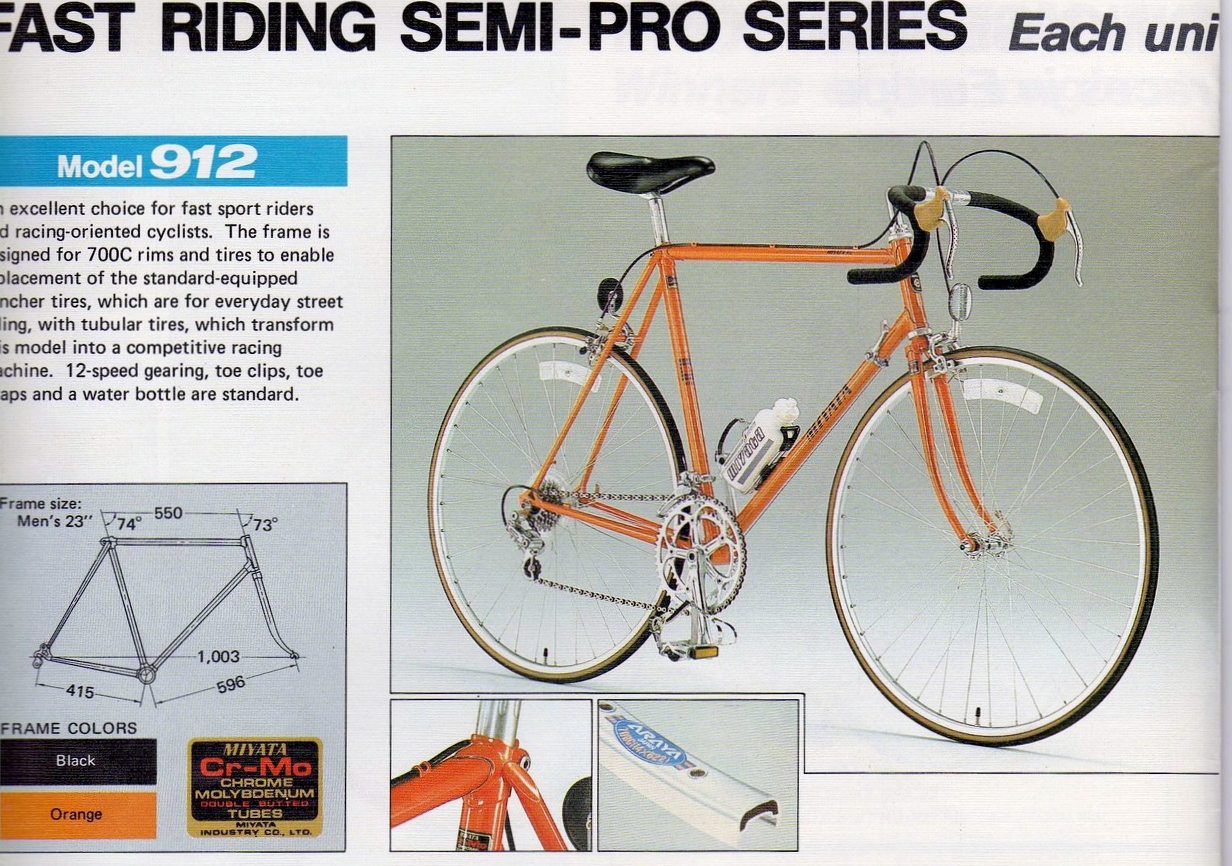
If there is a bike I can point to as the start of my old 10 speed obsession it would be the Miyata 912.  I had spent the winter and spring pouring over Randy's excellent Mytenspeeds site and I think by that time I had discovered OTSG and Hugh's bicycle blog as well.  Yes I had come down with the old steel 10 speed bug big time.  In April there was a local garage sale where a block had got together to raise money for the Japanese Tsunami disaster relief.  I thought it might be a chance to try to find a bike and practice my garage sale skills.   I arrive and find myself in a big backyard with wall to wall "stuff" none of which is a bike, so I wander into the garage where there is even more stuff but again no bicycle...until I look up.  Hanging from the rafters is what appears to be an old 10 speed!  I was so excited I didn't really even inspect it (Dumb) but found the lady who appeared to be in charge and asked "So is that bike in the garage, the one in the rafters, for sale?"  she says "its my husbands but he told me I could sell it, how much?"  I answer with the first number that comes into my head "how about $25?" she gets a great big grin on her face and says "That's great!".  As I am handing over my $$ she explains her husband used to commute on it a "few" years ago.  After paying the nice lady I go claim my prize and based on the dust on the frame and the cobwebs in the wheels I realize a "few" years ago might have been 20.  Once I am in the light I start seeing things that make my 10 speed nerd heart race; forged not stamped drop outs, gold lug lining, aluminum wheels, and -be still my heart- Shimano 600 Arabesque down tube shifters - YAHOO!
When I got home I did a bit more research and found that the Miyata 912 was a solid middle of the Miyata range sport-touring bike.  (1981 catalog shot -oldest I could find)


In addition to the normal dusty-musty-needs-alot-of-TLC factor this bike does have a few issues.
Its brake hoods are beyond salvation- my neighbor (a cyclist) described them as looking like "old bacon" apt.
While being stored upside down in the garage moisture had collected between the rear brake cable (running the length of the top tube) in spots and caused the paint to bubble and start some surface rust.  The crank was a funky triple combo of 48/46/28 which I found out from my LBS was called a mountain triple back in the day with the small ring as a bail out for hills.  That wasn't going to fly for the riding I intended, oh I forgot the best part -the bike was MY SIZE! I would discover in the coming months that finding a bike that really fit was not so easy. 

I spent the next few weeks very carefully disassembling the bike while referencing Zinn and the Art of road bike maintenance (my shop manual), Sheldon Brown and Mytenspeeds websites for instruction and inspiration.  carefully sanding the rusty blistered spot on the top tube and painting it -thank god for black!  I finally had it taken apart cleaned up and ready for being built back up.
I went with a cyclo-cross compact setup of 48/34 using the original Sugino crank.  I was inspired to spend some long hours getting this bike together so I could ride it on a fairly flat metric century I had promised to do with a friend in Salem Oregon in early May.  The bike rode like a champ and got some nice compliments.
I made several changes over the next year to the Miyata; a longer stem for better fit, wider bars (vintage Cinelli Giro D' italia), a new freewheel rear hub wheel-set from Velo Orange (the original rear came with an odd freewheel/cassette hybrid that started to fail), a nice brooks saddle and some spiffy whitewall red tread Panaracer tires.  Its probably a bit over the top but the least I could do for the bike that got me hooked on old steel.


Ride.Smile.Repeat

Thursday, January 10, 2013

1975 Peugeot UO-8 White 25" (December 2011)

Make: Peugeot
Model: UO-8
Year:  1975
Obtained: July 2011
Found: Bike Works 
Paid: $35.00

In the spring of 2010 I was in the university district of Seattle and a fixed up old 10 speed caught my eye, as they tend to, upon closer inspection it turned out to be a 70's Peugeot UO-8 in white with red accents.  I was really taken with the look and filed it away in my brain for later use.  In July of 2011 at the same time I found the 74 Grand Prix that I have written about I also found a 1975 white Peugeot UO-8 -now I could do my own red on white rebuild!
It was the usual story, musty, dusty and dirty but with some funky Mafac "half hood" brake levers, Racer brakes, "Aztec" lug cut outs and a head badge that reminded me of the buttons on a cigarette machine from the late 60s, you know the ones that were in the lobby of every restaurant in the US at the time.
Anyway I was really looking forward to working on this French beauty but after the debacle with the cottered crank on the Grand Prix I decided I would leave this alone until I had a proper tool to address the cotters.  As a result I didn't get to working on this bike until November. (1974 Catalog shot below couldn't find a 75)

I had initially though this might be a keeper but like the Takara it was a 25 inch frame and just too big for me.  Finally I had the proper tool and the time in November to tackle this beauty; I removed the "all original" (and pretty useless after 35 years) cables, housing, brake pads, dry rotted tires and tubes. And then got to work cleaning and waxing the frame, rebuilding the main bearings and getting the bike back to road worthiness.  Peugeot bikes of this era had simplex derailleurs and shifters, usually the front derailleur fails due to the use of a plastic clamp but in the case of this UO-8 the FD was fine, it was rear that would not work properly.  That was really the only real issue I had with the bike and it was solved with a vintage Shimano Titlist in nice shape and of about the same era.
With my new Cotter press the cotters practically fell over themselves getting out of the crank so I could rebuild the bottom bracket and clean up the crankset.
With some gentle scrubbing and cleaning the rubber half hoods and lever protectors came out very nice.
And my vision of a white Peugeot UO-8 with red accents became a reality.

The red walled tires might have been a bit over the top but what the heck I liked the look and the bike sold fast to a nice tall young man at the UW.  A really good resource for old Peugeot info, especially dating them, is http://retropeugeot.com/.   By dating I mean figuring out when the bike was made, because taking a bike out on a date would be just wrong and odd....right? 


Little did I know that this purchase was only the first in what would be a long line of UO-8's for me.  Allez Allez!

Ride.Smile.Repeat.

Tuesday, January 8, 2013

1985 Raleigh Marathon Mixte (September 2011)

Make: Raleigh
Model: Marathon (Mixte)
Year:  1985
Obtained: August 2011
Found: Bike Works 
Paid: $30.00


As I mentioned in the post regarding the 1974 Raleigh Grand Prix, after  one too many setbacks I had to walk away from that project (temporarily).  This is what I walked towards, a 1985 Raleigh Marathon.  One thing I could have added to my beginning bike refurbisher post was don't start out with just a frame when fixing up a bike.  It can be expensive tracking down all the parts and you might not get it right the first time.  However if you have become a bit bike obsessed you might have acquired more than a few spare parts.  Heck you might even have some nice ready to go parts from a stupid project that sent you to a bad place and made you walk away and....but I digress.
I was drawn to this bike because it was in great shape and had wonderful details, a cut above your average Record or Grand Prix.  I hadn't walked into the Bike Works warehouse intending to buy just a frame, at the cost I normally spent on a full bike, but I couldn't pass this one up.

It had great fork crown details
More great stuff on the seat stays
A gorgeous head badge -note this is a Raleigh of America badge

And a lovely Raleigh branded alloy crankset
It did have a hideous gold bulky quick release seat clamp that I ditched for the Raleigh branded one from the '74 Grand Prix.  I also had a set of wheels I had cleaned up and trued, with rebuilt hubs and cool white walled tires that had been intended for the Grand Prix that went nicely with this bike.  I was going to use the center pull brakes from the Grand Prix as well until I realized I needed side pulls to make the rear brake work on the this  mixte frame (in the picture at the bottom of the post note the cable loop has to come up to the rear brake rather than down to it as it would on a mens frame).  I also took a nice set of SR Road Champion drop bars with engraving off my 1979 Miyata (future post), since I was planning to put something wider on the Miyata,  and put them on this little gem along with some Suntour Power Ratchet stem shifters.  The white bar tape, pedal straps and cable housing were also purchased for the Grand Prix but went well with this bikes color scheme and detailing.

In retrospect I probably spent more than I should have building this up and asked too little for it based on its condition but it did sell fast to a nice lady who seemed very happy to have it.  One of my favorites bikes that I have worked on so far.

Ride. Smile. Repeat.

Saturday, January 5, 2013

1974 Raleigh Grand Prix (Nov 2011)

I got this bike, along with a white Peugeot U0-8, from my favorite bike finding location Bike Works the local bike co-op.  They do good work for the community, they have great prices on project bikes and they usually have a good variety -whats not to like?  Little did I know when I selected this Bronze Green beauty that I would be in for some major education.
It was your typical musty dusty 70's 10 speed and I figured hey "how hard can this be"  the cotters on the Takara were no problem so this should be a breeze..... WRONG.
I started as normal with taking the bike apart down to the frame and fork.  When I got to the crank that is when the problems began.  My use-a-big-C-clamp method with a socket over the threaded end of the cotter method which had worked great on the Takara totally failed.  The process devolved into bitter feud with me a hammer and a punch on one side and the cotter on the other.  Long story short I effectively wrecked the crank removing the cotter.  I went to a bad place, fortunately no pictures exist of that fateful day.  In the end I spent more $$$ on a bike tool than ever before and got a Bikesmith design cotter press and in subsequent rehabs of cottered cranks it has served flawlessly.

Here's a shot of just how grimy an old 10 speed can get also notice the cool, proprietary brake cable holder on the Gran Prix.  Word to the wise do NOT lose the small cable bolt that screws into that bridge.
So I destroyed the cottered crank, no big deal I had a spare 3 piece bottom bracket and I picked up a vintage 3 piece crank set so problem solved....WRONG.  Raleigh in their infinite wisdom had their own threading on some of the early 70s bikes, not British standard noooo they used a Raleigh proprietary threading so my British bottom bracket cups for the 3 piece crank did not work with the Grand Prix bb.  At that point I walked away from this bike and worked on other projects for a few months.  When I came back to it I ended up using the original cottered crank BB cups, that I had saved thank goodness!, and got a used cottered bb spindle and yes another freaking cottered crank.  Oh the irony.  To top it off I realized on getting home that the crankset I had selected was a 52/45 set up.  In hilly Seattle a 45-28 low gear ain't gonna cut it so I had to scrouge around to swap the 45t inner  for a more manageable 40t chain ring.  Finally the crankset all came together.
After the *&^%$#@ crank situation the rest of the bike went together fairly easily.  I did some white accents that I think turned out well
It  ended up being a pretty nice bike when finished, that sold to a friend of a friend who wanted to start bike commuting.  So that whole thing about avoiding cottered cranks if you are a first timer in my last post- this is why ;-)


Thursday, January 3, 2013

A note to new 10 speed refurbishers

After refurbishing 14 bike boom era 10/12 speeds over the last 18 months I have learned a few things about the process-mostly by messing up! So in the hopes that even one prospective bike refurbisher can learn from my mistakes/experience/pain/tears I thought I would put together a list of guidelines:  Working on old 10 speeds for the beginner.  This comes with a big dose of IMHO and is by no means complete but as this time of year is reflective I have been giving this some thought for a few days and wanted to get it down on (virtual) paper:

  1. Read up before you wrench.  One thing I did a decent job of was doing alot or reading before I ever started taking an old 10 speed apart. With the internet there is an enormous wealth of knowledge out there; excellent links, blogs, video,  exploded diagrams etc.  You can use my blog and links lists as a starting point but I would advise googling away and see what you find.  Its also good to have a flesh and blood resource like your local bike shop (LBS) or a friend with skills and tools.  Finally good old paper is nice to have, I use a well thumbed copy of Zinn and the art of Road bike Maintenance, people also rave about Parks tools Big blue book , and I have found that you can pick up 70s era bike maintenance books for pennies via Amazon.com Such as; The Complete book of bicycling -Sloane, Richards Bicycle Book -Ballantine, and Anybody's bike book -Cuthebertson to name a few.
  2. Be Picky.  There were literally Millions of 10 speeds built in the bike boom era so don't feel like you have to jump at the first bike you come across, as you develop a network of places to look ( that's a post for another time) you will start to realize there are plenty of bikes out there so if bike you find doesn't speak to you and or isn't dirt cheap and/or free then walk on by.  A few of my rules are;
    1. Is it lugged?  Have I mentioned I love lugs?  Based on my experience selling refurbished 10 speeds lots of other people do to.  They are just classy and usually mean at least a bit of craftsmanship went into the bike.
    2. Is it a bike I would want for myself?  Its my hope that if the bike speaks to me it will speak even louder to prospective buyers after I am finished giving it a huge does of TLC.
    3. Is it an "average" size?  Now I am a pretty averaged sized guy at just shy of 6 feet so I am biased here but mostly I look at this from the prospective pool of buyers.  There are alot more folks out there in the 52cm to 62cm frame size then there are at the extremes.
    4. Is the price right?  This is going to depend on whether you buying a bike to build for yourself versus buying one to rebuild.  The bikes I have spent the most on were ones I intended to keep so I wasn't as worried about turning a profit but the less you pay up front the more room you have for profit.  More on pricing when I write about finding bikes in a future post.
    5. Does it have an obvious problems? I will talk more about this below but try to put aside your lust for beautiful lugged bikes for a minute and look at this prospective project bike critically is there a bent wheel or a missing part or wait a sec is the fork bent? 
  3. Give it a critical eye.  Remember these bike are 30 plus years old and they may an issue or two, you want to discover a deal breaker or issue up front not after you get the bike home, it may also help you bargain with the seller.   Some common issues to look for;
    1. Damage to the frame or fork, a small ding in the tubes is one thing a major bend or crack is a red flag.  Randy at MyTenSpeeds has a great article about this.
    2. Bent or badly out of true wheels.  Give the wheels a spin do spin freely or do they rub on the brakes?  If the bike wobbles like a drunk frat boy that might mean it needs more than just a bit of truing.  Do you have the skills to tackle that?
    3. Stuck stem or seat post?  If you can bring some allen wrenches and box end open end wrenches with you so can loosen the seat post collar and stem bolt and see if both them move freely up and down, if they do no worries and if not you might have just found a big PIA.  Don't forget to snug up the bolts after you do this check.  While stuck stems and seat posts are not insurmountable problems they can add a lot of work and time to a refurb and may also indicate a level of neglect (lack of grease on these parts) that may extend to other parts of the bike 
    4. Rust?  These are Steel bikes so rust isn't uncommon but there is a little rust here and there in paint scratches and there is systematic left-outside-by-the-seashore-for-decades rust.  If you have a bike with a good deal of rust, and probably not good paint, then you may be looking at sanding down and repainting the bike.  Again not an insurmountable problem but it does add considerable time and expense to the project and once you take off original paint and decals etc your bike loses some of its "collectable" value if that matters to you.
    •  
  4. A few things to avoid.  At least until you get some projects under your belt, I ignored all three of these guidelines and learned alot but also had some major frustration along the way:
    • Bikes with cottered cranks due to potential issues with removing cotters without special tools or other methods.  Look for my upcoming post on the 74 Raleigh Grand Prix where I had this issue.
    • French bikes before 1982 due to proprietary threading and sizing.  Again more info on this in future posts.
    • Department store bikes (Sears, JC Penny's, Wards etc) nothing wrong with them but most are cheaply built and with so many great bikes out there from England, Japan, France (see above), Italy etc you have a number of better bikes to choose from, this gets back to being picky.  See my recent post on the Sears Free Spirit.
  5. Have Fun! I mean otherwise why do it?  The whole process of finding a bike is kind of like a treasure hunt and and the end of the line you have hopefully found a diamond in the rough that you can bring back to life for your own enjoyment or someone else's. 
Before
After